
Last Updated: Nov 7, 2026
Step 1: Respond to the Injury and Secure the Scene
Getting medical help to an injured worker comes first, always.
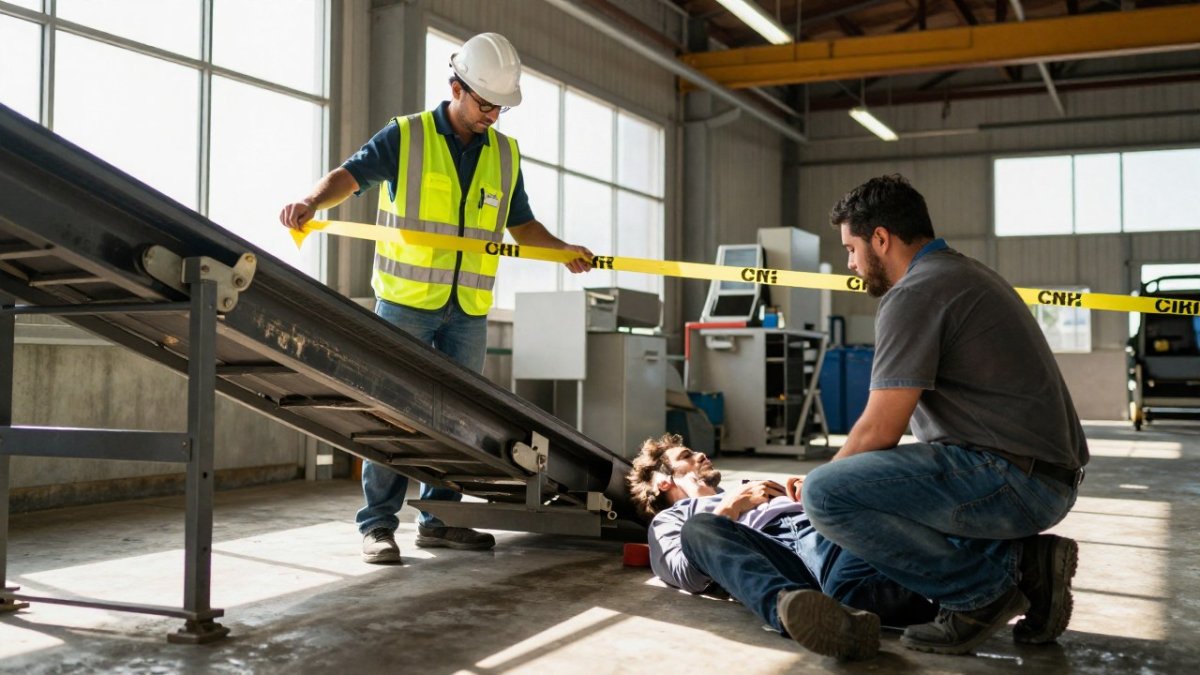
A delayed response can turn a routine claim into a dispute. The first hour often sets the tone for everything that follows.
Here is the order that works:
- Call emergency services for serious injuries. Do not move a worker who may have a spinal injury.
- Give first aid if trained staff are on hand.
- Remove the hazard if you can do so safely.
“Secure the area” means exactly that. Do not clean up, move equipment, or restart the line until someone has photographed the scene.
Keep the injured employee’s family informed. A short phone call goes a long way.
Step 2: Follow Your Workplace Incident Investigation Procedure
A workplace incident investigation procedure is the written sequence your company follows after any injury, near miss, or dangerous event. It names who leads, what gets documented, and how fast each step happens. Most employers already have one. The problem is that few people have read it since it was written, and fewer still can tell you what it actually requires on the day of an injury.
Pull out your procedure the same day. Then check five things:
- Who is the designated investigation lead, and who is the backup when that person is the one injured or on vacation?
- What are the internal reporting deadlines, to the supervisor, to safety, to HR, to risk management?
- Which forms must be completed, and in what order?
That last pair is where procedures most often fail. Investigation steps get written down; reporting clocks and retention rules get assumed.
Separate the three clocks
A defensible procedure runs on three timelines that are easy to blur together:
- Emergency response clock, minutes. Medical care, hazard control, scene security. Nothing else competes with this.
- Investigation clock, hours to days. Witness interviews, photo documentation, evidence preservation, and the initial report. Evidence degrades fast; memories and physical conditions both change.
- Follow-up clock, days to weeks. Root-cause analysis, corrective actions with owners and due dates, verification that fixes held, and return-to-work coordination.
Write these as three distinct phases in your procedure, with a named owner for each. When they are collapsed into one undifferentiated checklist, the follow-up phase is the one that quietly gets dropped.
Know your reporting and recordkeeping obligations
Reporting thresholds, deadlines, and required records vary by jurisdiction and by the size and type of operation. A serious injury, a fatality, or a hospitalization typically triggers a much shorter reporting window than a first-aid case, and the specific forms and retention periods differ from one regulator to the next.
Watch out: assuming a near miss carries no reporting duty. Many frameworks treat certain near misses and dangerous occurrences as reportable even when no one was hurt, and a missed report is hard to explain later.
Build the procedure so it survives scrutiny
A procedure that is thin, outdated, or inconsistently applied creates a paper trail suggesting some injuries are treated differently than others. That is exactly the kind of gap that draws scrutiny. Review the procedure after every incident closes, not during one, and note what worked, what was ambiguous, and what needs to change.
If your procedure is thin or outdated, fix it after this incident closes. Do not improvise in the middle of one.
Step 3: Gather Facts, Document the Scene, and Preserve Evidence
Fact finding starts with the physical scene. Photograph everything before anything moves.
Your evidence gathering should cover:
- Wide shots of the whole area, then close-ups of the hazard
- The equipment involved, including guards, switches, and controls
- Positions of the worker, tools, and materials at the time of injury
Label each photo with the date, time, and location. Store them somewhere secure.
Preserve physical evidence too. Bag damaged parts. Keep the broken ladder or the faulty guard.
Sequence of events matters here. Write a simple timeline: what happened first, second, third.
A blame-free investigation gets better facts. Workers who fear punishment hide details.
Step 4: How to Interview Witnesses After a Workplace Accident
Interview witnesses separately, and do it as soon as practical. Group interviews produce one story, not five. The goal is a factual, voluntary account, not a confession, and not a version of events that matches what you already believe happened. Keeping each account independent makes interviewing witnesses more useful for establishing what happened before assumptions take hold.
Here is how to interview witnesses after a workplace accident without contaminating what they tell you:
- Meet one on one, in a quiet space away from the scene and away from supervisors.
- Open with a neutral framing: “I’m trying to understand what happened so we can prevent it from happening again. You’re not in trouble.”
- Ask open questions first: “Walk me through what you saw, starting from when you arrived.”
Use a trauma-informed approach
A witness who just watched a coworker get hurt may be shaken, in shock, or unable to recall details in sequence. That is normal, and it is not evasiveness. Give them a moment. Offer water. Let them pause. Do not push for detail they cannot recall, and do not treat a gap in memory as a sign of dishonesty. If a witness is too distressed to continue, stop, document where you got to, and offer to resume later.
Remove barriers to a fair account
Language access. If a witness is more comfortable in another language, use a qualified interpreter, not a coworker, and not a family member. Brief the interpreter to translate questions and answers exactly, without summarizing or editorializing.
Confidentiality. Tell witnesses who will see their statement and why. Avoid promising secrecy you cannot keep; instead, explain how the record will be used and protected.
Power dynamics. Do not have the injured worker’s supervisor conduct the interview. A witness who reports to the person asking the questions may shade the account to protect themselves or a colleague.
Avoid leading questions
Leading questions plant answers. “So the guard was missing, right?” tells the witness what you expect to hear. Ask “What did you notice about the guard?” instead. The same applies to tone: a skeptical or accusatory delivery changes what people are willing to say.
A blame-free investigation gets better facts. Workers who fear punishment hide details. Workers who feel safe tell you what actually happened.
Document the interview itself
Record who was interviewed, when, where, by whom, how long it took, whether an interpreter or support person was present, and whether the witness confirmed the statement. Note anyone who declined to be interviewed and any reason given. That metadata matters as much as the statement, it shows the process was consistent and fair.
Step 5: Complete a Workplace Accident Investigation Form
The workplace accident investigation form is the record that ties the whole process together. Fill it out completely, and do it the same day when possible.
A solid form captures:
- Field: Injured employee — What to Record: Name, job title, shift, hire date
- Field: Injury details — What to Record: Body part, injury type, severity, treatment given
- Field: Time and place — What to Record: Exact date, time, and location on site
- Field: Witnesses — What to Record: Names and contact details
- Field: Equipment involved — What to Record: Make, model, condition, inspection history
- Field: Sequence of events — What to Record: Short factual timeline
- Field: Immediate cause — What to Record: What directly led to the injury
- Field: Contributing cause — What to Record: Underlying conditions or practices
- Field: Corrective action — What to Record: Steps taken or planned
- Field: Signatures — What to Record: Investigator, supervisor, reviewer
Write facts, not opinions. “The floor was wet near the press” beats “the employee was careless.”
If you are weighing whether a claim can be denied, read the legal grounds employers can use to deny workers comp claims before you finalize the form.
Step 6: Write the Investigation Report and Corrective Action Plan
An investigation report turns raw facts into a clear account of what happened and why. The corrective action plan then says what changes.
Keep the report short and factual. Include:
- A one-paragraph summary of the incident
- The sequence of events
- Root cause and contributing causes
Root cause is the part most reports get wrong. “Employee slipped” is not a root cause.
Corrective actions need three things: a named owner, a deadline, and a way to verify the fix worked. Follow-up is where safety programs quietly fail. Set a review date and check that the change actually stuck.
If a claim seems questionable after your review, our guide on how to challenge workers comp claims effectively walks through the steps.
What a Workplace Incident Report Sample Should Include
A workplace incident report sample shows how the finished document should read. Use it as a template, not a script.
A complete sample includes the header with company and location, the employee’s details, a plain-language description of the event, the injury and treatment, witness names, the equipment involved, the immediate and contributing causes, and the corrective actions with owners and dates.
Write in plain language. Avoid jargon and blame. Stick to what can be verified.
Here is a short sample entry:
“At 9:15 a.m., an employee on the second shift caught their hand between a roller and a guard on Line 3. The guard was present but loose. The employee received first aid on site and was taken for evaluation. The area was secured at 9:20 a.m. Two witnesses were interviewed. The guard was removed for inspection. Corrective action: maintenance to reattach and torque all guards on Line 3 by end of week. Owner: shift supervisor.”
Notice what the sample does not do. It does not assign fault. It does not guess at cause. It records and points to a fix.
When to Bring in Counsel for Workplace Injury Investigations
Bring in counsel when the injury is serious, when fault is unclear, or when a claim looks disputed.
Call us when:
- The injury is severe or involves a hospital stay
- A worker hints at a claim or hires an attorney
- The cause points to a safety failure you knew about
If you are unsure whether to engage counsel, learn how to book a workers comp defense consultation and what documents to prepare.
You can also review our practice areas and services to confirm we handle workplace injury defense. When you are ready to talk, connect with our team directly.
Workplace injury investigations reward preparation and punish improvisation. The employers who document early, interview fairly, and close the loop on corrective actions stay out of trouble.
Frequently Asked Questions
What are the five steps of a workplace incident investigation?
Most workplace injury investigations follow five steps: provide immediate care and secure the scene, select an investigation lead and team, gather facts and document evidence, interview witnesses and involved employees, and complete a written report with corrective actions. A follow-up review confirms the fixes worked. Skipping any step weakens the findings and makes it harder to prevent recurrence.
How do you interview witnesses after a workplace injury?
Interview witnesses separately and as soon as practical, before memories fade or stories merge. Ask open questions about what they saw, heard, and did, and record answers in their own words. Keep the tone blame-free so people share details rather than defend themselves. Document the date, time, and location of each interview, and have the witness review the written summary for accuracy.
What should be included in a workplace injury investigation report?
A complete report covers the date, time, and location of the incident; who was involved and who witnessed it; a description of the injury and the medical attention given; the sequence of events; workplace conditions, equipment, and work practices at the time; root and contributing causes; and the corrective actions assigned with owners and deadlines. Attach photographs, the accident investigation form, and witness statements.
How can employers identify the root cause of a workplace injury?
Move past the immediate cause to ask why the unsafe condition or act existed. Review equipment maintenance records, training logs, and work practices, and compare what the procedure required with what actually happened. A root cause is usually a system gap, such as missing guarding, unclear instructions, or production pressure that encouraged a shortcut. Address that gap, not just the individual involved.

