Quick Summary
Yes, you can sue for breach of a verbal contract in the United States, as long as it meets the same basic requirements as a written one: offer, acceptance, consideration, and mutual intent to be bound. The real question is usually whether you can prove the agreement existed, so outcomes often turn on evidence rather than memory.
- A verbal contract is enforceable without a witness, notary, or paper for the contract to exist.
- The Statute of Frauds requires certain agreements, like land sales, to be in writing.
- The burden of proof is a preponderance of the evidence, meaning more likely true than not.
- Preserve texts, emails, payment records, and witness details as soon as a dispute begins.
- The limitations clock generally starts when the breach occurs, not when you discover it.
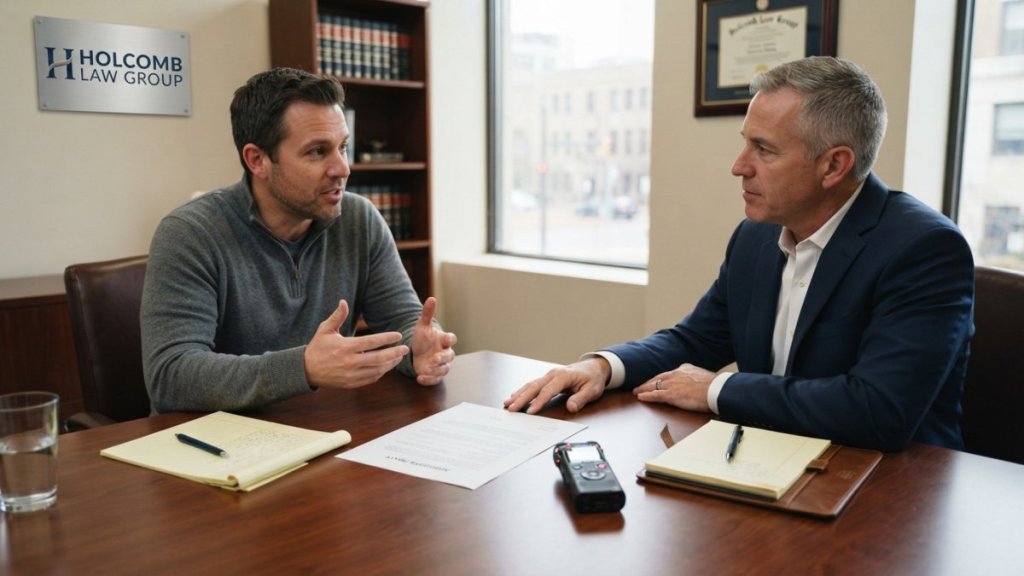
Handshake deal gone wrong? Holcomb Law Group reviews your evidence and explains your options for a verbal contract dispute.
Can You Sue for Breach of a Verbal Contract?
Yes, you can sue for breach of a verbal contract in the United States.
That distinction matters. Courts hear these cases regularly, and outcomes often turn on evidence rather than memory.
Below, we explain what makes an oral agreement enforceable, which agreements must be in writing, what evidence holds up, and how to calculate what you are owed.
What Makes a Verbal Contract Legally Enforceable
A verbal contract is enforceable when it contains the same core elements as any written agreement. No witness, no notary, and no paper are required for the contract to exist.
The Core Elements of Contract Formation
Contract formation rests on four pillars. Miss one, and you may have no enforceable contract at all.
- Offer: One party proposes clear terms.
- Acceptance: The other party agrees to those terms.
- Consideration: Each side gives something of value, such as money, goods, or work.
- Mutual assent: Both parties share a meeting of the minds on the key terms.
Intent to be bound matters too. A casual comment about future plans is not a contract. A firm promise exchanged for value usually is.
When the Statute of Frauds Requires a Written Agreement
The Statute of Frauds is a set of state laws requiring certain agreements to be in writing (statute of frauds | Wex | US Law). Common categories include:
- Contracts for the sale of land
- Agreements that cannot be performed within one year
- Promises to pay another person’s debt
- Certain sale-of-goods contracts above a state-set threshold
If your agreement falls into one of these categories, a purely verbal deal may be unenforceable.
A verbal contract holds up in court when it has the same core elements as a written one.
- Element: Offer — What it means: One party proposes clear terms
- Element: Acceptance — What it means: The other party agrees to those terms
- Element: Consideration — What it means: Each side gives something of value
- Element: Mutual assent — What it means: Both parties share a meeting of the minds
Verbal Contract Examples That Courts Actually See
Verbal contract examples show up in everyday business. A contractor agrees by phone to remodel a kitchen.
These disputes share a pattern. One side performed, the other did not pay or did not deliver. The disagreement is rarely about whether people talked.
Small service agreements, commission arrangements, and short-term vendor deals make up much of this caseload.
Verbal Agreement Evidence: What You Need to Prove Your Case
Verbal agreement evidence decides these cases. The burden of proof in a civil lawsuit is a preponderance of the evidence, meaning more likely true than not (preponderance of the evidence | Wex | US Law).
Strong evidence includes:
- Written communications: texts, emails, and messages that reference the terms
- Payment records: invoices, bank transfers, canceled checks
- Witness testimony: people who heard the offer or the acceptance
- Performance evidence: work completed, materials delivered, schedules kept
Credibility matters as much as paperwork. For a deeper look at what courts require, see our guide on how to prove breach of contract in court.
Building an Evidence Checklist and Preservation Plan
Start preserving evidence the day the dispute begins. Do not delete texts. Do not clean out email folders. Export messages with dates and sender details intact.
- Screenshot and back up all texts and messages
- Export email threads as PDFs with headers
- Pull bank and payment records for every transaction
- List every witness with contact details and what they heard

Breach of Contract for Nonpayment: When Words Cost Money
Breach of contract for nonpayment is the most common verbal dispute we see.
The distinction shapes your remedy. Material breach can excuse your own future performance and support a damages claim.
Continuing to perform after nonpayment without objection can weaken your position, so consider sending a written demand early and keeping a record of it.
How Long Do You Have to Sue for Breach of Contract?
How long you have to sue for breach of contract depends on your state’s statute of limitations.
The deadline is not one national number. Each state legislature sets its own periods, and courts in that state interpret when the clock starts. That is why two identical handshake deals can have different filing windows depending on where the parties live or do business.
How the Clock Actually Starts
The limitations period generally begins to run when the breach occurs, not when you discover it. If a contractor promised to finish work by a set date and did not, the clock usually starts on that missed date.
Some states apply a discovery rule in limited circumstances, starting the clock when the injured party knew or should have known of the breach.
Written Versus Oral Periods
Many states pair a longer window for written contracts with a shorter one for oral agreements. The logic is that written terms are easier to verify, so the law gives them more time.
Sale-of-goods claims add another layer. States that have adopted a version of the Uniform Commercial Code typically apply a specific limitations period to contracts for the sale of goods, which may differ from the general oral-contract window.
Tolling and Other Ways the Clock Pauses
A few mechanisms can pause or extend the limitations period. Tolling may apply while a defendant is out of the state, while a party is a minor or incapacitated, or while the parties are engaged in certain formal alternative dispute processes.
These rules are state-specific and fact-specific. A demand letter alone usually does not toll the statute, which is why sending one is not a substitute for filing on time.
How to Identify Your Applicable Deadline
- Find the state whose law governs. Usually that is where the defendant resides, where the contract was performed, or where the breach occurred. If the parties are in different states, choice-of-law rules decide.
- Check that state’s statute of limitations for written contracts, oral contracts, and sale-of-goods claims.
- Pin down the breach date and count forward, accounting for any tolling that may apply.
- Confirm with the court’s self-help resources or counsel before relying on any deadline.
Watch out: a deadline that looks comfortable can shrink once you account for the breach date, partial-performance arguments, and state-specific tolling rules. For general background, the Legal Information Institute at Cornell Law School explains contract law basics.
Choosing the Right Court and Calculating Your Damages
Choosing the right court comes down to two questions: how much is at stake, and where the parties live or do business. Small claims court handles modest amounts with simple procedures. A civil lawsuit in a higher court fits larger claims and complex facts. Jurisdiction and choice-of-law issues can complicate matters when the parties are in different states.
A Practical Decision Tree for Court and Claim
- Claim is small and facts are simple? Small claims court is usually the fastest path.
- Claim is larger or facts are disputed? File in the appropriate civil court.
- Parties are in different states? Confirm jurisdiction and which state’s law applies before filing.
- Contract involves land? The court where the property sits generally hears the case.
Damages Calculation with Realistic Examples
Damages aim to put you in the position you would have held had the contract been performed. Expectation damages cover the benefit of the bargain. Reliance damages cover costs you spent in reliance on the deal.
Example: a vendor agrees to supply goods for a set price. For a full method, see our step-by-step guide on calculating contract damages.
Resolving the Dispute Before You File
Most verbal contract disputes settle before a courtroom, and the steps you take before filing often shape the outcome more than the filing itself. A structured pre-lawsuit sequence does two things: it gives the other side a clear chance to perform or pay, and it builds a documented record of your good-faith efforts that a judge or mediator will see.
Step 1: Send a Written Demand Letter
A demand letter states the facts, the amount owed or the performance required, and a firm deadline. Keep it factual and specific:
- Identify the parties and the agreement, including when and how it was formed.
- Describe what you performed and what the other side failed to do.
- State the amount owed or the specific performance you want.
- Set a clear deadline for response, typically a short window measured in days or weeks.
Send it by a method that creates proof of delivery, such as certified mail with return receipt, and keep a copy. A demand letter is not a legal filing, but it often prompts payment or a settlement conversation.
Watch out: a demand letter that overstates the claim or misstates the facts can be used against you later. Keep every figure tied to documents you can produce.
Step 2: Document Every Settlement Effort
Keep a dated log of every call, email, and meeting about the dispute. Note who said what, when, and what was agreed. If the other side offers a partial payment or a payment plan, put the terms in writing before accepting. A written record of settlement discussions shows the court you tried to resolve the matter in good faith.
Step 3: Try Mediation
Mediation gives both sides a structured path to resolution without a judge. A neutral mediator helps the parties identify the disputed facts and explore a settlement. Mediation is often faster and less expensive than litigation, and many courts require parties to attempt it before a hearing. If mediation produces an agreement, get it in writing and signed.
Step 4: Decide Whether to File
If negotiation and mediation stall, litigation may be the right next step. Holcomb Law Group handles commercial litigation matters, and you can contact the firm to discuss your evidence and deadlines before you commit to filing.
A verbal agreement can be enforced, but only when the proof holds up. If you are facing a dispute over an oral deal, gather your records now and get a clear read on your options.
Frequently Asked Questions
Do verbal contracts hold up in court?
Yes, a verbal contract can hold up in court if it meets the basic elements of contract formation: offer, acceptance, consideration, and mutual assent. However, some agreements, such as those involving land or contracts that cannot be performed within one year, must be in writing under the Statute of Frauds. For enforceable verbal contracts, the challenge is usually proving the terms and the breach, not the existence of the agreement itself.
What evidence can help prove a verbal agreement?
Strong evidence for a verbal agreement includes text messages, emails, payment records, invoices, witness testimony, and any written notes or memos that reference the terms. Even a handshake agreement can be supported by subsequent conduct, like partial performance or reliance on the promised terms. Preserve all communications and keep a timeline of events.
How long do you have to sue for breach of contract?
The deadline to sue for breach of contract is set by each state’s statute of limitations. Because these deadlines can be shortened or extended by specific circumstances, consult a lawyer promptly to avoid missing your filing window.
Can a text message or email help prove a verbal contract?
Yes, text messages and emails are often powerful evidence in a verbal contract dispute. They can show the offer, acceptance, and terms discussed, and may even satisfy the writing requirement in some cases. Courts routinely admit digital communications as evidence. Save all messages, avoid deleting threads, and back up your data.

